minFraud Release Notes
Improved readability of the risk reasons module within Transactions Details screen
May 13, 2026Based on user feedback, we have updated the risk reasons module within the minFraud Transactions Details screen for improved readability.

For increased clarity, we have renamed ‘Multiplier’ to ‘Signal Strength’ and added a color gradient and visual scaling to provide a baseline reference and show the magnitude of each risk reason.
We have also updated the explainer text under ‘Risk Reason’ to include more details.
Subset of risk score reasons can now be used in custom rules
May 13, 2026You can now integrate a selection of risk score reasons into your custom rules. This update is available in the minFraud Score, Insights, and Factors service tiers.
Risk score reasons are a set of data that provide you with specific and understandable reasons for why a risk score is high or low. Learn more about risk score reasons, or learn how to create a custom rule.
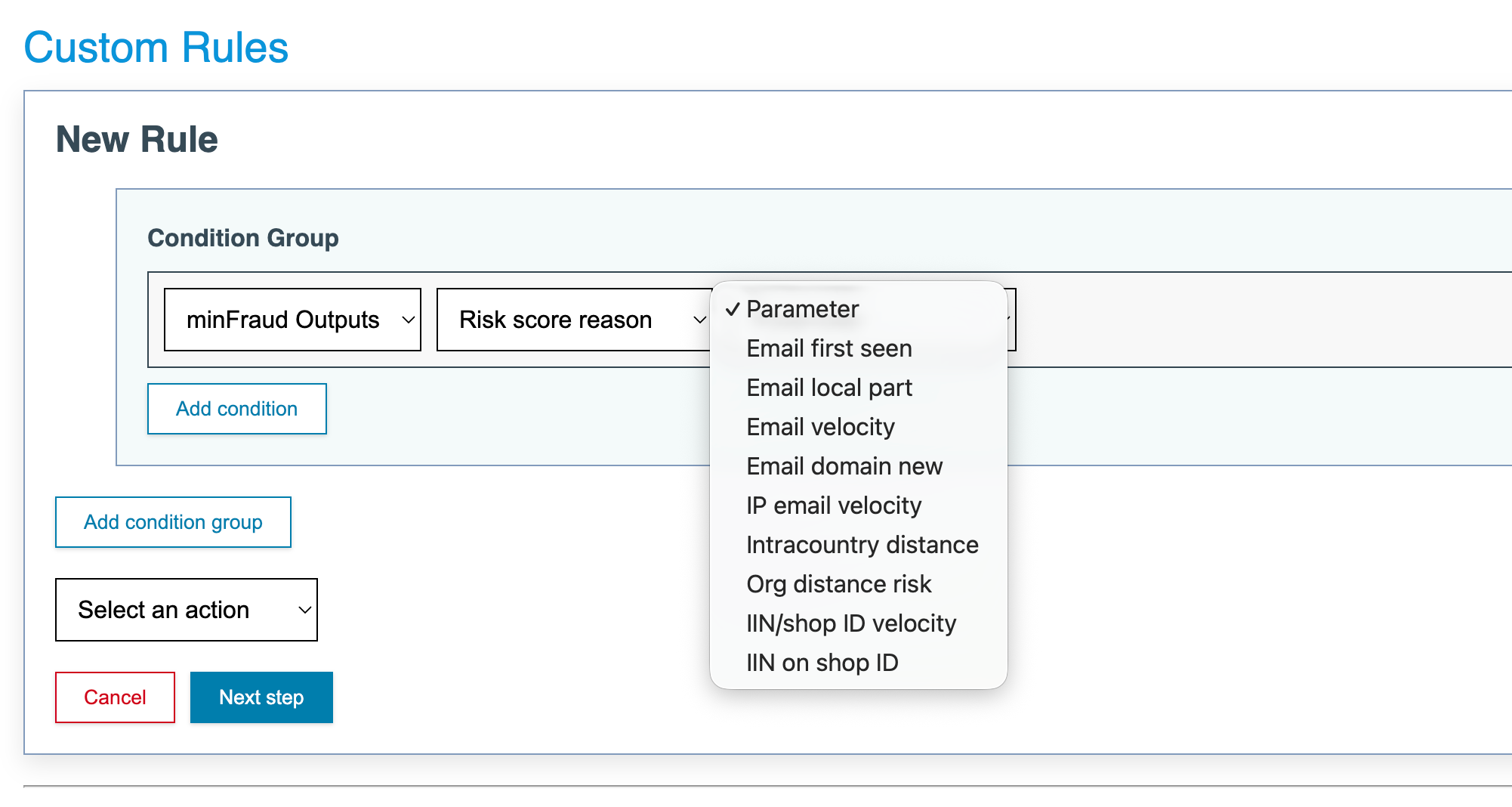
The current risk score reasons able to be used as part of a custom rule are:
- Email first seen
- Email local part
- Email velocity
- Email domain new
- IP email velocity
- Intracountry distance
- Org distance risk
- IIN/shop ID velocity
- IIN on shop ID
If you would like other risk score reasons to be added, please reach out to our Product team at product@maxmind.com.
Transaction classification can now be untagged using the `clear` report tag
May 13, 2026You can now clear a transaction report tag if the initial classification was or
is now incorrect. The new clear tag restores a transaction to an untagged
state. This is distinct from the not_fraud tag which signals the transaction
is legitimate.
Reporting transactions as chargebacks, suspected fraud, spam/abuse, or false positives helps MaxMind detect 10–50% more fraud and reduce false positives for you.
The clear tag is available via the Report Transaction API, the transaction
report web form, and minFraud Interactive.
Native mobile SDKs now available for device tracking
May 13, 2026minFraud device tracking is now available for native Android and iOS apps.
Each SDK and the web-based JavaScript returns a trackingToken you pass as an
input to your minFraud request—a meaningful improvement for mobile networks
where many devices share a single IP.
The MaxMind Device SDK for Android collects device data and sends it to MaxMind so that the minFraud service can assign a Device ID and begin collecting fingerprint information.
The MaxMind Device SDK for iOS collects device data and sends it to MaxMind so that the minFraud service can assign a Device ID and use it to detect fraud across sessions. The SDK exposes both a Swift API and an Objective-C API; Objective-C classes use an MM prefix.
Email addresses and phone numbers to be hashed before storage
May 12, 2026As a security improvement, MaxMind will begin hashing all email addresses and phone numbers submitted to the minFraud service before storing them on our servers. No changes to your integration are required. We will continue to accept plaintext values in API requests, and API responses will be unaffected.
Starting July 6, 2026, minFraud Interactive will display the hashed form of email addresses (plus the plaintext domain) and phone prefixes (the first 6-7 digits identifying country code and carrier) in place of full plaintext values, both in your transaction list and when drilling into individual transactions.
If your team relies on viewing full email addresses or phone numbers during manual review, you can opt in to plaintext display in minFraud Interactive by emailing product@maxmind.com.
You may opt in at any time after the transition date; however, plaintext display will apply only to transactions received after your opt-in date. Transactions processed after July 6 but before your opt-in will remain hashed.
Updates to geolocation confidence factors
March 23, 2026Starting tomorrow, Tuesday, March 24 2026, we’re deploying updates to our geolocation confidence factors to make them more accurate.
For networks located outside of the United States, we will be adjusting country level confidence to be higher in circumstances where those networks are used exclusively in a single country.
For all networks, we will be improving the accuracy of our subdivision, city, and postal confidence. These will be minor changes. Most significantly, some subdivision confidence values of 99 will be reduced to 95.
The following products and services will be improved:
- minFraud Insights web services
- minFraud Factors web services
- GeoIP Insights web service
- GeoIP Enterprise database
Updates to user count data
March 4, 2026Between Tuesday March 3 and Friday, March 6, 2026 (and possibly longer), we are making daily updates to the user count data to more often return a value of 0 or 1 for residential proxies.
Previously, approximately 50% of residential proxy IPs on single household IPs had a user count value of at least 2, and 50% had a value of 0 or 1. This update will make it easier to flag a high volume of customer profiles on a residential proxy as anomalous in relation to a lower user count value of 0 or 1.
Please see an explanation of user counts below:
| User count | Description |
|---|---|
| 0 | IP assigned to a single end-user at a time (household, person, or small business), or not in use. |
| 1 | IP assigned to a single end-user with possibility of multiple end-users. |
| 2 | IP shared with multiple end-users. |
| >5 | IP shared with many end-users. |
Number of minFraud custom inputs increased to 100
February 17, 2026You are now able to add up to 100 custom inputs in minFraud.
Custom inputs allow you to pass data that is relevant to your business and fine-tune minFraud custom rules to help identify suspicious transactions and reduce fraud.
Custom inputs are available to users of all minFraud service tiers: Score, Insights, and Factors.
Updates to autonomous_system_organization, ISP, and organization data
January 28, 2026On January 21, 2026, we released data with significant changes to
autonomous_system_organization and less significant changes to isp and
organization data.
Customers can expect to see in many cases improved, more readable versions of
autonomous_system_organization and, in some cases, small changes to isp and
organization data.
This change is reflected in the following products and services:
- minFraud Insights web service
- minFraud Factors web service
- GeoLite ASN database
- GeoLite City web service
- GeoIP ISP database
- GeoIP Enterprise database
- GeoIP City Plus web service
- GeoIP Insights web service